
On this page
- What is cassava value addition?
- Why it matters for young farmers in Uganda
- Three cassava products you can start with
- How to make high quality cassava flour in 8 steps
- How to make dried cassava chips
- Keeping cassava products safe
- Find a buyer before you process
- Five mistakes that cost cassava processors money
- How AYAFSI can help
Cassava value addition means turning fresh cassava roots into products that last longer and sell for more, such as dried chips and high quality flour. For young farmers in Uganda it is one of the fastest ways to earn more from a crop they already grow. This guide explains why it matters, how to make flour and chips step by step, how to keep them safe, and how to find a buyer.
What is cassava value addition?
Value addition is any step that makes a raw crop worth more to a buyer. With cassava, that usually means peeling, drying, milling and packaging the roots so they can be stored, transported and sold to bakeries, food processors, schools and shops.
The raw root is cheap and perishable. The processed product is lighter, keeps for months and reaches buyers who will never buy fresh roots.
Why it matters for young farmers in Uganda
Fresh cassava does not wait. Researchers describe a process called postharvest physiological deterioration: the flesh turns bluish black within 24 to 72 hours of harvest, and roots can become unfit to eat, process or sell within about two days (ICAR CTCRI). Farmers who cannot sell quickly are forced to accept whatever price is offered.
Processing changes that. In January 2020, Farm Radio reported that farmers in Oyam district, northern Uganda, sold fresh cassava for about UGX 1,500 per kg, while high quality cassava flour sold for about UGX 6,000 per kg. Prices vary by market and season, so check current prices where you live, but the principle holds: dried, clean, packaged cassava reaches better buyers.
Value addition also creates work beyond the farm. Peeling, drying, milling, packing and selling are jobs that young people can do in their own communities.
Three cassava products you can start with
| Product | What it is | Who buys it | Start-up need |
|---|---|---|---|
| Dried cassava chips | Peeled roots cut thin and dried | Millers, animal feed makers, traders | Low: knives, raised drying racks, bags |
| High quality cassava flour | Unfermented flour made within a day of harvest | Bakeries, food processors, breweries, households | Medium: grater, press, access to a mill |
| Fermented cassava flour | Traditional flour from soaked or heaped roots | Local markets, households | Low, but quality varies more |
Most groups start with chips, then move to high quality flour once they have a reliable drying space and a buyer.
How to make high quality cassava flour in 8 steps
Farm Radio describes the basic process as peeling, washing, grating, pressing, drying, milling and sifting. Here it is in order, with what to watch at each step.
- Harvest only what you can process the same day. Start processing within 24 hours, before the roots begin to spoil.
- Peel the roots completely. The peel holds more cyanogens than the flesh; FAO notes that peeling alone can cut them by at least half.
- Wash in clean water. Remove all soil and peel fragments so the flour stays white.
- Grate the roots finely. A motorised grater saves hours compared with hand grating.
- Press out the water. Pack the mash in clean sacks and press it until no more liquid drips out. Drier mash dries faster and grows less mould.
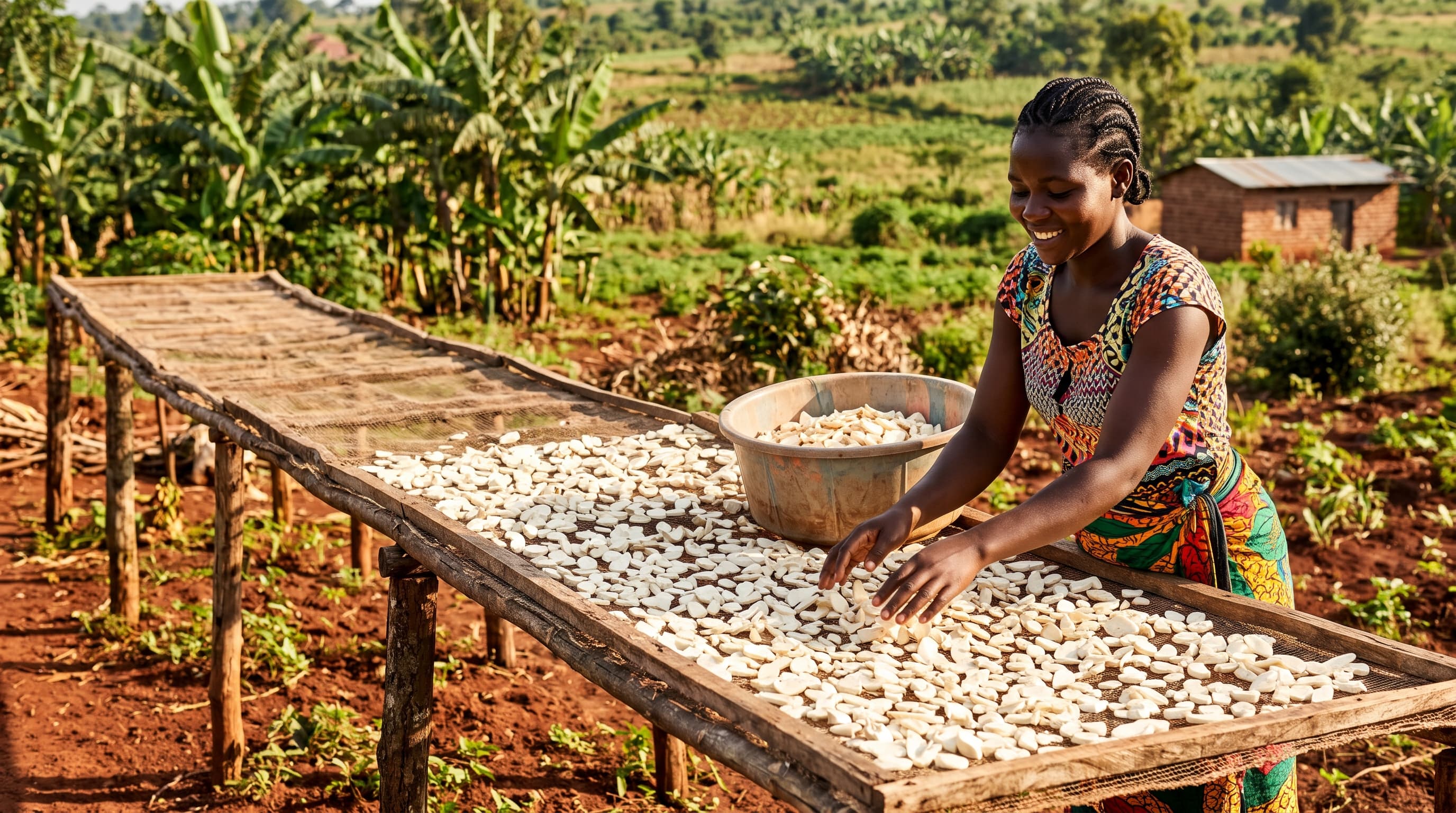
- Dry on raised racks or clean tarpaulins, never on bare ground. Spread thinly, turn often and cover from rain. Dry until the product snaps and crumbles, at most 12% moisture.
- Mill and sieve. Use a clean mill and a fine sieve for a smooth, even flour.
- Pack and label. Use clean, dry, sealed bags, labelled with the product name, weight, date and your group's name and phone number.
How to make dried cassava chips
Chips are the simplest product and a good place to begin. Peel and wash the roots, slice them about 3 to 5 mm thick, and spread them in a single layer on raised racks in the sun. Turn them two or three times a day and bring them under cover at night and when it rains. They are ready when they break cleanly with a snap. Store them in clean bags on pallets, off the floor and away from walls.
Keeping cassava products safe
Cassava contains natural compounds that can release cyanide, and damp products can grow moulds. Buyers check for both, so safety is also good business.
- Peel, process and dry properly. Peeling, soaking, fermenting and drying all reduce cyanogens, according to FAO.
- Dry it fully. The East African standards for dried cassava chips (EAS 739) and cassava flour (EAS 740) set a maximum of 12% moisture and 10 mg/kg total cyanide.
- Prevent mould. Slow drying in damp conditions can encourage moulds linked to aflatoxin. Dry quickly, in thin layers, and never pack damp product.
- Keep it clean. Clean hands, tools, water and bags. Keep animals away from drying areas.
- Ask about certification before selling packaged flour. Contact the Uganda National Bureau of Standards (UNBS) to learn what your product needs before you supply shops or institutions.
Find a buyer before you process
The most common mistake is producing first and looking for a market later. Talk to buyers first and agree on four things: the product, the quality, the volume and the price or price range.
Useful buyers to approach include bakeries and food processors, breweries and starch makers, school feeding suppliers, supermarkets and wholesale traders. Selling as a group helps you meet larger orders, share transport and negotiate better. Keep simple records of what you produce, sell and spend, because buyers and banks trust groups that can show their numbers.
Five mistakes that cost cassava processors money
- Leaving harvested roots for more than a day before processing.
- Drying on bare ground, which adds soil, stones and mould.
- Cutting chips too thick, so they stay damp inside.
- Packing before the product is fully dry.
- Mixing good and poor batches in the same bag.
How AYAFSI can help
AYAFSI's first pilot will work with young people aged 18 to 35 who already grow cassava in one Ugandan district, from February to July 2027. Participants get 12 practical sessions, a mentor, hands-on value addition, financial literacy, and introductions to buyers and banks. Read how our programmes work or meet AYAFSI.
The programme is free, and AYAFSI never asks participants for money. To join, apply here or call or WhatsApp +256 794 011 241. Buyers, funders and banks can partner with us.
Start Local. Build African. Connect Global.
Frequently asked questions
What is cassava value addition?
It means turning fresh cassava roots into products that last longer and sell for more, such as dried chips, high quality flour and packaged products.
How long do fresh cassava roots last after harvest?
Only a short time. Roots begin to discolour within 24 to 72 hours and can become unfit to sell or process within about two days, so process them within a day of harvest.
How do you make high quality cassava flour?
Harvest, then peel, wash, grate, press out the water, dry thinly to 12% moisture or less, mill, sieve and pack, all starting within 24 hours of harvest.
Is cassava flour safe to eat?
Yes, when it is processed properly. Peeling, quick processing and full drying reduce natural cyanogens, and the East African standard sets a limit of 10 mg/kg total cyanide in cassava flour.
Who buys cassava flour and chips in Uganda?
Bakeries, food processors, breweries, animal feed makers, school feeding suppliers, supermarkets and traders. Agree on quality and volume with a buyer before you process.
Does AYAFSI charge for its cassava training?
No. AYAFSI programmes are free for participants, and AYAFSI never asks participants for money. Report anyone who asks for payment on +256 794 011 241.
Published 4 November 2026 · Updated
All articles